
Hiring Exterior Cleaners for HOA Compliance: 2026 Guide
Table of Contents
- What HOA Compliance Means for Exterior Cleaning
- Services Included in HOA Exterior Cleaning Packages
- Pressure Washing Insurance Requirements for Contractors
- Soft Washing vs Pressure Washing for Homes
- How to Handle HOA Violation Notices for Dirty Siding
- How to Choose an Exterior Cleaner for HOA Compliance
- Cost-Benefit Analysis for Long-Term HOA Cleaning Contracts
- Frequently Asked Questions
Last Updated: September 27, 2026
What HOA Compliance Means for Exterior Cleaning
HOA compliance for exterior cleaning means meeting your community’s written standards for how buildings, driveways, roofs, and common areas must look, and proving the work was done to those standards. This guide from Crystal Clear Windows explains how to hire exterior cleaners for HOA compliance without triggering fines or damaging property.
Most boards learn this the hard way: a violation letter arrives, someone hires the cheapest crew, and three months later the algae is back and the fines resume.
The real problem is not dirty siding. It is that most homeowners treat cleaning as a one-time fix instead of a scheduled maintenance item. According to the [U.S.
HOA compliance is a documentation and scheduling problem as much as a cleaning problem. Keep records of every service visit, and you can answer any violation notice in minutes.
Services Included in HOA Exterior Cleaning Packages
A standard HOA-focused package covers soft washing for siding and roofs, pressure washing for concrete, and hand cleaning for glass and fixtures, scoped to your community’s materials.
- Soft washing for stucco, painted siding, and shingle roofs
- Pressure washing for driveways, walkways, and pool decks
- Roof cleaning to remove black streaks caused by algae
- Paver sealing to lock in color and slow regrowth
- Window and fixture cleaning on shared and private structures
Pressure Washing Insurance Requirements for Contractors
-
Commercial general liability (CGL). Responds when a crew damages a wall, cracks a window, stains a driveway, or injures a third party. Ask for an occurrence-form policy, not claims-made, because occurrence coverage responds to incidents during the policy period even if the claim is filed later. A common minimum is $1,000,000 per occurrence and $2,000,000 general aggregate, though your governing documents may set a higher floor.
-
Workers’ compensation. Every state except Texas requires employers to carry workers’ comp, and limits and exemptions vary by state. An injured worker on association property can create liability for the board if the contractor is uninsured. Ask for the carrier name, policy number, and state where the policy applies. If the provider claims an exemption, ask for the exemption certificate number and confirm it with the issuing state agency.
-
Commercial auto. Cleaning rigs, trailers, and trucks park in community lots and drive on private roads. Commercial auto covers damage those vehicles cause. Personal auto policies typically exclude business use, so a contractor hauling equipment on a personal policy may have no coverage.
-
Umbrella or excess liability. Sits above the CGL and workers’ comp limits. It matters most for large communities with high-value structures, pools, or clubhouses.
-
Pollution or runoff coverage. Standard CGL policies contain a pollution exclusion that can bar claims from cleaning chemicals or wastewater entering storm drains. If your community sits near a waterway or municipal storm system, ask whether the provider carries a pollution liability endorsement or separate environmental policy.
-
Request a certificate of insurance (COI) directly from the provider’s insurance agent or broker, not from the contractor
-
Confirm the policy is currently active and not expired or cancelled
-
Check that the CGL limit matches or exceeds your community’s vendor requirements
-
Confirm the association is listed as an additional insured on the CGL
-
Verify workers’ compensation coverage or a valid, documented state exemption
-
Confirm commercial auto coverage for all vehicles used on the property
-
Ask whether the provider carries pollution or runoff coverage
-
Request a waiver of subrogation in the association’s favor, if your governing documents allow it
-
Save a copy of every certificate, endorsement, and exemption with the contract
A certificate of insurance is not proof of coverage on its own. Certificates can be issued and then cancelled, and an additional-insured endorsement is only valid if it is actually attached to the policy. Call the insurer or broker to confirm the policy is active on the day work begins, and ask them to email the endorsement page, not just the COI. If you skip this step, you may discover the gap after damage occurs.
Ask about runoff as well. Many communities sit near storm drains or waterways, and local rules restrict what detergents can enter those systems. A provider who cannot explain how they contain and dispose of wastewater is a risk, not a bargain.
Soft Washing vs Pressure Washing for Homes
Soft washing and pressure washing for homes differ in one key way: soft washing uses low pressure and cleaning solutions, while pressure washing uses high-pressure water to blast away dirt. Choosing the wrong method is the fastest way to void a warranty or crack a surface.
| Surface | Recommended Method | Why It Matters |
|---|---|---|
| Stucco and painted siding | Soft washing | High pressure cracks the finish |
| Asphalt shingle roof | Soft washing | Pressure strips granules and shortens roof life |
| Concrete driveway | Pressure washing | Tolerates higher force for deep stains |
| Pavers | Pressure washing plus sealing | Sealing slows regrowth and locks sand |
| Limestone and masonry | Soft washing | Porous stone erodes under pressure |
| Windows and glass | Hand cleaning | Pressure forces water past seals |
Ask the provider to describe their mix ratio and dwell time for the cleaning solution. A crew that cannot answer is guessing, and guessing on stucco or limestone is how surface restoration turns into surface replacement.
How to Handle HOA Violation Notices for Dirty Siding
Handling an HOA violation notice for dirty siding starts with reading the notice and confirming the deadline. Most notices specify a cure period, often 10, 15, or 30 days, and missing it converts a warning into a fine. Find the exact number first.
- Photograph the cited surface from the same angle shown in the notice, and note the date and time
- Check the community’s governing documents for the exact standard cited, including any architectural guidelines that define acceptable appearance
- Contact a licensed exterior cleaning provider and request a written scope with a scheduled service date
- Schedule the work before the cure deadline, not on it, and leave buffer for weather delays
- Send the board a short written response with the service date, before-and-after photos, and the invoice
Template: Resident Request to the Board for a Cure-Period Extension
If weather or scheduling makes the deadline unrealistic, request an extension in writing before it passes. Boards are far more likely to grant one to a homeowner who communicates early than to one who goes silent.
Template: Board Notice to Residents Before a Community-Wide Cleaning
When the board schedules community-wide exterior cleaning, residents need advance notice to move vehicles, unlock gates, and secure pets. A short, specific notice prevents most day-of problems.
Template: Board Violation Notice for Dirty Siding
Boards should send violation notices that are specific, dated, and cite the exact standard. Vague notices invite disputes and are harder to enforce.
Keep every notice, response, photo, and invoice in one folder, whether paper or digital. If a dispute ever reaches a hearing or mediation, a clean paper trail is the difference between a closed file and a prolonged fight.
How to Choose an Exterior Cleaner for HOA Compliance
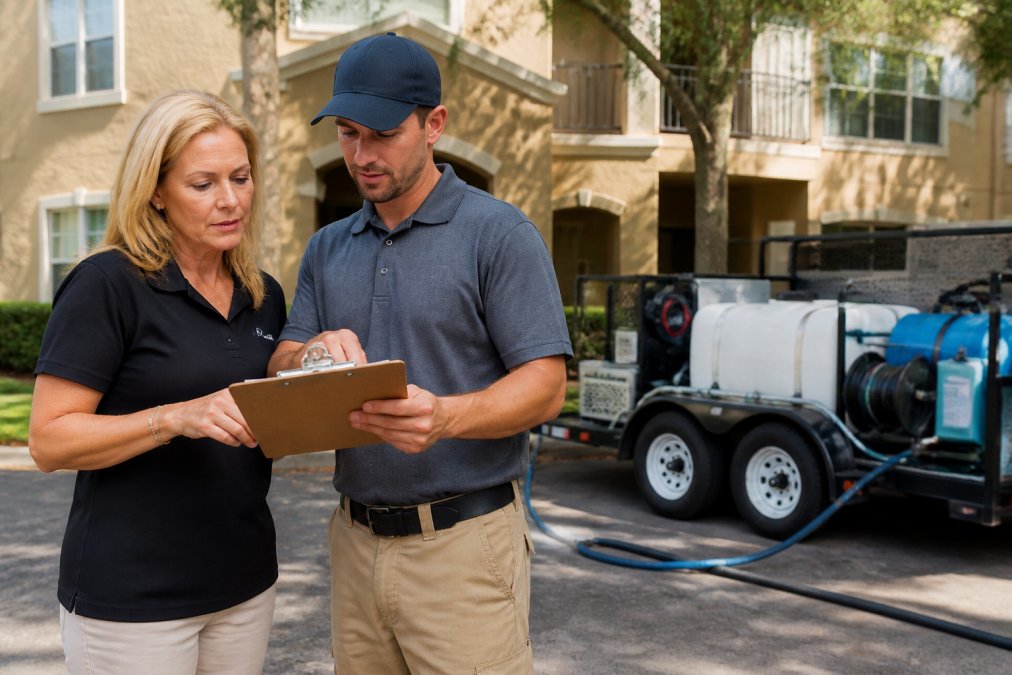
Choosing an exterior cleaner for HOA compliance comes down to four checks: licensing, insurance, surface-specific methods, and documentation. A provider who passes all four keeps your community out of violation files.
| Criteria | What to Check | Weight |
|---|---|---|
| Licensing and registration | Current state or local registration on file | High |
| Insurance verification | Active general liability and workers’ comp | High |
| Surface expertise | Named methods for stucco, roof, pavers, concrete | High |
| Documentation | Written scope, before-and-after photos, service log | Medium |
| Environmental practices | Runoff containment and detergent disclosure | Medium |
| References | Recent community or commercial jobs you can call | Medium |
Cost-Benefit Analysis for Long-Term HOA Cleaning Contracts
Long-term HOA cleaning contracts usually cost less per visit than one-off calls and reduce violation risk because surfaces never reach visible neglect. The savings come from scheduling, not discounts.
The cheapest quote is rarely the cheapest outcome. A low bid that damages stucco or strips a roof costs the community far more than the difference in service pricing.
- One-off cleaning: variable cost per call, unpredictable timing, higher violation risk
- Biannual contract: fixed cost per visit, scheduled around weather, lower violation risk
- Quarterly contract: highest annual cost, lowest surface degradation, best for high-visibility communities
Frequently Asked Questions
What exterior cleaning services are typically required by HOAs?
Most HOA governing documents require pressure washing of driveways, walkways, and common areas, soft washing of stucco and siding, roof cleaning to remove algae and black streaks, and regular window cleaning. Some communities also mandate paver sealing and gutter clearing. Requirements vary by community, so review your specific CC&Rs before hiring a contractor. A professional exterior cleaning company can confirm which services keep your property within residential community standards.
How do I ensure my exterior cleaning contractor meets HOA insurance requirements?
Ask for a certificate of insurance showing general liability coverage, and verify it lists your HOA as an additional insured if required. Confirm the policy is current by calling the insurer directly. Check that the contractor carries workers’ compensation coverage and holds any state or local licenses your community requires. This protects the HOA from liability if a worker is injured or property is damaged during pressure washing or soft washing.
What is the difference between soft washing and pressure washing for HOA compliance?
Pressure washing uses high-pressure water to blast away dirt and stains from hard surfaces like concrete driveways and pavers. Soft washing uses low pressure combined with detergent application to clean delicate surfaces such as stucco, limestone, and roofing shingles. Using the wrong method can damage surface integrity and create costly repairs. A qualified contractor will match the technique to each surface, which keeps your community compliant without risking damage.
How often should I schedule exterior cleaning to stay in good standing with my HOA?
Most HOAs expect exterior cleaning at least once a year, though Florida’s humidity and rainfall often make semi-annual service necessary to control algae, mold, and mildew. Roofs and stucco may need cleaning every 12 to 18 months, while driveways and walkways benefit from annual pressure washing. Building a preventative maintenance schedule with your contractor prevents violation notices and keeps curb appeal consistent year-round.